The usual suspects
- Rubber washing machine hoses, especially older than five years
- Plastic refrigerator and ice maker lines
- Dishwasher supply and drain connections under the sink
- Toilet and faucet supply connectors and angle stops
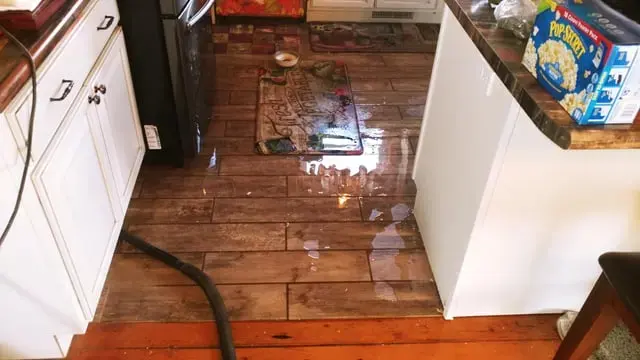
A split washer hose or a failed ice maker line runs until someone notices. Water goes under cabinets, into the subfloor and along the slab. The extraction crew and drying team handle it.
(888) 527-9134Appliance leak? Start the Carrollton dry-out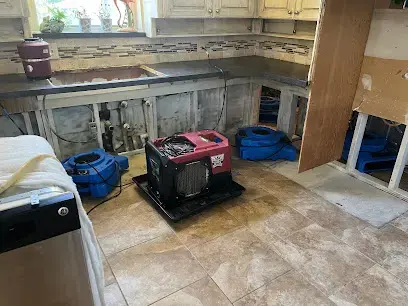
Turn off the appliance shutoff, or the main if the valve is stuck.
Unplug the appliance only if the plug and outlet are dry.
Move rugs and stored items; open cabinet doors to let air in.
Record the failed hose and the wet floor, then call for drying.
Carrollton water damage pros work day and night and roll with truck-mounted extraction, air movers and moisture meters on board.
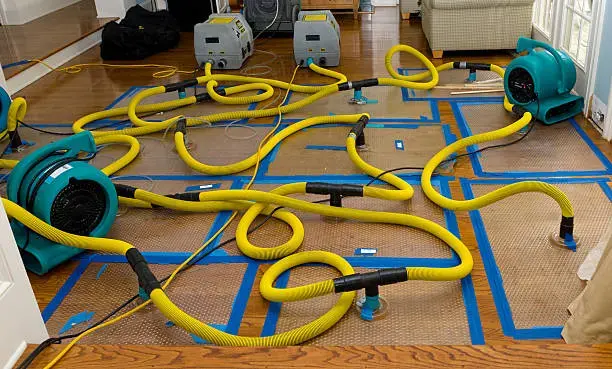
IICRC S500 is the industry drying standard. The drying team runs structural drying, not just surface drying, and equipment stays until the readings say dry.
A moisture map from day one, daily psychrometric logs and timestamped photos before any demolition: the file an adjuster works from.
Slab leaks in shifting clay, hail-opened roofs and attic AC drains are everyday calls here, so the crew knows where water hides in a North Texas house.
In Carrollton, TX, appliance supply line leak cleanup typically runs $900 to $6,500 or more. The drivers are how long the line ran, whether cabinets and hardwood are involved, the water category and how fast drying started.
These are typical ranges, not a quote. For a closer planning number try the water damage cost calculator.
The response team rolls 24/7. The tech who does the walkthrough finds the source and maps moisture with thermal imaging and pinless meters before any appliance supply line leak equipment goes down.
The extraction crew pulls standing water with truck-mounted extraction so it leaves the building instead of moving to the next room.
Air movers set to each room's evaporation load and LGR dehumidifiers pull the moisture out of framing, drywall and slab.
Readings are logged daily. Equipment comes out when wet materials sit within 2 to 4 points of a dry reference, and the logs go in the claim file.
Supply hoses and connectors are the most common source of indoor water damage, and they fail quietly. A rubber washer hose bulges and splits, a plastic ice maker line cracks behind the fridge, a toilet connector lets go overnight. By the time water shows at the edge of the kitchen, it has usually spread under the cabinets and along the slab.
Water runs under base cabinets and sits on the slab or subfloor where no air reaches it. Cabinet bottoms made of particleboard swell and fall apart once they soak. The mitigation team pulls toe-kicks and sometimes the dishwasher to reach the water, and uses injection drying to push dry air under the cabinets.
Cheap insurance for the laundry room: braided stainless supply hoses and a leak sensor under the washer and the sink.
EPA WaterSense explains how to find leaks around the home, and CPSC posts appliance safety recalls. Wood floors hit by a leak are covered on the hardwood floor water damage page.
The Carrollton restoration crew works every part of the city across ZIPs 75006, 75007, 75010, 75011, from Old Downtown Carrollton, Josey Ranch, Indian Creek, Country Place, Trinity Mills, Hebron out to Farmers Branch, Addison, Coppell, Lewisville, The Colony, Plano and Far North Dallas.
See every area and ZIP coveredRubber washer hoses are commonly replaced about every five years. Braided stainless hoses last longer and fail less suddenly.
Often, if drying starts quickly. The mitigation team removes toe-kicks and dries under and inside the cabinets. Particleboard that has swollen or crumbled usually has to be replaced.
A supply hose leak is clean Category 1 water. Water from the drain side or the drum is usually Category 2 and is handled with more caution.
Water spreads under walls along the slab. Moisture mapping checks adjacent rooms so hidden wet areas get dried too.
It can. Ice maker lines leak slowly and often run for days behind the fridge, soaking the floor and the base of the cabinets before anyone notices.
Sudden discharge is often treated differently from a slow, repeated leak. Coverage depends on your policy, so it is worth checking with your own insurer.
Shut off the water if you can, keep clear of wet outlets, and call. The drying team maps the moisture and gets extraction started.